How to Say "Both" in Russian: оба, обе and и ..., и ...
Both in Russian is not always оба. Learn when to use оба and обе, when you need и ..., и ..., and how to say neither.
Three English sentences with both, one with neither — and four different Russian constructions:
- I speak both Russian and English. — Я говорю́ и по-ру́сски, и по-англи́йски.
- Tea or coffee? — Both. — Чай и́ли ко́фе? — И то, и друго́е.
- I like neither. — Мне не нра́вится ни то, ни друго́е.
- Both books are new. — О́бе кни́ги но́вые.
Only the last one uses о́ба or о́бе. That's the short answer, and if it already looks clear, head to the Exercises tab at the top of the page and check yourself. Everything below goes through the four one at a time.
One of my students was telling me where she had lived and got as far as я жила́ о́ба… — then stopped, because she could hear it wasn't working. The English sentence in her head was "I have lived both in a small village and in a big city," and both is о́ба, so о́ба is what came out.
This is the most common way the word goes wrong, and it's worth fixing before anything else. So let's start with what о́ба is actually for.
When you need о́ба
О́ба is a counting word. It works like два and две — it counts nouns. О́ба means the two of them, these two.
There are three situations where you need о́ба/о́бе.
1. There is a noun, and there are two of them.
- О́бе кни́ги но́вые. — Both books are new.
- О́ба бра́та живу́т в Москве́. — Both brothers live in Moscow.
- Я купи́л о́ба биле́та. — I bought both tickets.
2. There is a pronoun: мы, вы, они́.
- Мы о́ба э́то зна́ем. — We both know it.
- Они́ о́бе у́чат ру́сский. — They are both learning Russian.
- Вы о́ба опозда́ли. — You were both late.
3. The noun is not in the sentence, but it's clear from the context.
- Каку́ю кни́гу взять? — Бери́ о́бе. — Which book should I take? — Take both. (both books)
So if you can replace both with these two or the two of them in English, о́ба/о́бе works:
- Both books are new. → These two books are new. ✓
- We both know it. → The two of us know it. ✓
- I speak both Russian and English. → These two, Russian and English? No — so о́ба doesn't work.
What о́ба cannot do
О́ба cannot connect two parts of a sentence. It only attaches to a noun or a pronoun.
- Я жила́ о́ба: в дере́вне и в го́роде. — wrong
- Я жила́ и в дере́вне, и в го́роде. — correct (и ..., и ... is literally "and …, and …" — it gets its own section later.)
If there is nothing for о́ба to attach to, you need a different construction.
You can bring о́ба back if you give it a noun:
- Я жила́ в обо́их места́х: и в дере́вне, и в го́роде. — I have lived in both places: in a village and in a city.
So: о́ба first — which form to use, and what happens to the words around it. The other three constructions come after that.
О́ба or о́бе: choosing by gender
Which form you use depends on the gender of the noun you're counting. (Not sure how to tell the gender? Start here.)
- о́ба — masculine and neuter
- о́бе — feminine
Examples:
- о́ба бра́та — both brothers
- о́ба окна́ — both windows
- о́бе сестры́ — both sisters
- о́бе кни́ги — both books
A man and a woman together take о́ба. Mixed groups default to masculine, the way they do everywhere else in Russian:
- Брат и сестра́. О́ба пришли́. — A brother and a sister. Both of them came.
- Ма́ма и па́па о́ба на рабо́те. — Mom and dad are both at work.
Only two forms — and Russians get them wrong all the time. There was a whole wave of memes about it fifteen years ago, and this is my favorite one. The poll asks кто до́лжен де́лать пе́рвый шаг? — who should make the first move? The options: па́рень (a guy), де́вушка (a girl), and обо́и.
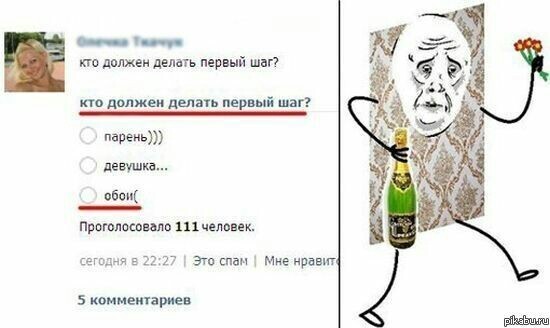
Обо́и means wallpaper. Different word, different stress, no connection. 😅
The noun after о́ба and о́бе
The same thing that comes after два and две — the genitive singular, not the plural:
- два бра́та → о́ба бра́та — both brothers
- две сестры́ → о́бе сестры́ — both sisters
- два окна́ → о́ба окна́ — both windows
Everything after the noun goes plural:
- О́ба бра́та пришли́. — Both brothers came.
- О́бе сестры́ живу́т в Москве́. — Both sisters live in Moscow.
- О́ба окна́ откры́ты. — Both windows are open.
- О́ба фи́льма интере́сные. — Both films are interesting.
Adjectives and possessives after о́ба
This is the most confusing part of the topic, and it's confusing for a real reason. Everywhere else in Russian, the words that describe a noun repeat its form — the noun decides, everything describing it copies. Here that breaks. The noun is in one form, the word describing it is in another, and they don't match.
It's a leftover from the dual, a special "two of something" number that Russian used to have and lost centuries ago. There's no live logic underneath it anymore, so the honest advice is to memorize the two patterns. They work the same way for adjectives, for possessives like мой, and for demonstratives like э́тот:
- masculine and neuter: genitive plural
- feminine: nominative plural
Examples:
- о́ба но́вых до́ма — both new houses
- о́ба больши́х окна́ — both big windows
- о́ба мои́х бра́та — both my brothers
- о́ба э́тих фи́льма — both these films
- о́бе но́вые кни́ги — both new books
- о́бе мои́ подру́ги — both my friends (female)
- о́бе э́ти шко́лы — both these schools
The same thing happens after 2, 3 and 4:
- два но́вых до́ма, три но́вых до́ма, четы́ре но́вых до́ма — two, three, four new houses
- две но́вые кни́ги, три но́вые кни́ги, четы́ре но́вые кни́ги — two, three, four new books
From five upward everything agrees again: пять но́вых домо́в, пять но́вых книг.
This mismatch only shows up in the nominative — the form you use when the phrase is the subject of the sentence. It also shows up when the phrase is the object and the noun is a thing, because that form copies the nominative: Я купи́л о́ба но́вых биле́та. — I bought both new tickets. In every other case everything matches again, all plural:
- Я зна́ю обо́их но́вых студе́нтов. — I know both new students.
- Я говори́л с обе́ими мои́ми подру́гами. — I spoke with both my friends.
- Мы говори́ли об обо́их э́тих фи́льмах. — We talked about both these films.
Мы о́ба, вы о́бе, они́ о́ба
With pronouns the word order flips: о́ба comes second.
- мы о́ба / мы о́бе — both of us
- вы о́ба / вы о́бе — both of you
- они́ о́ба / они́ о́бе — both of them
English speakers reliably build this the other way round — о́ба нас, from "both of us." Russian doesn't do that. The pronoun leads, о́ба follows.
Case forms: обо́их, обе́их, обо́ими
Good news here: о́ба and о́бе take ordinary plural adjective endings. If you can decline си́ний, you already know these:
- обо́их / обе́их — like си́них
- обо́им / обе́им — like си́ним
- обо́ими / обе́ими — like си́ними
Two things move. The stress: о́ба and о́бе carry it on the first syllable, and every other form pulls it onto the ending — обо́их, обо́им, обо́ими, обе́их, обе́им, обе́ими. This one hides well — people write the forms correctly and then say them with the stress still at the front. And the stem: обо- for masculine and neuter, обе- for feminine. One letter in the middle of a word you're saying quickly.
| Case | masculine / neuter | feminine |
|---|---|---|
| кто? что? (nominative) | о́ба | о́бе |
| кого́? чего́? (genitive) | обо́их | обе́их |
| кому́? чему́? (dative) | обо́им | обе́им |
| кого́? что? (accusative) | обо́их / о́ба | обе́их / о́бе |
| кем? чем? (instrumental) | обо́ими | обе́ими |
| о ком? о чём? (prepositional) | обо́их | обе́их |
Two notes on that table.
The accusative has two forms. People and animals take обо́их / обе́их; objects keep о́ба / о́бе.
- Я зна́ю обо́их бра́тьев. — I know both brothers.
- Я купи́л о́ба биле́та. — I bought both tickets.
The noun goes plural everywhere except two cells of the table: the nominative, and the accusative when it keeps о́ба / о́бе. That's why Я купи́л о́ба биле́та above has биле́та and not биле́ты. Everywhere else the noun is plural:
- Я говори́л с обе́ими сёстрами. — I spoke with both sisters.
- Он позвони́л нам обо́им. — He called both of us.
- Мы говори́ли об обо́их фи́льмах. — We talked about both films.
- Я купи́ла пода́рки обе́им подру́гам. — I bought presents for both friends.
If the case names are new to you, the guide to how Russian cases work explains what each one is for.
Fixed phrases with о́ба and о́бе
Frozen phrases are where о́ба actually turns up in everyday speech, and they're worth learning whole — no grammar required.
- обе́ими рука́ми «за» — I'm all for it (literally "for it with both hands")
- в обо́их слу́чаях — in both cases
- о́ба ра́за — both times
- по о́бе сто́роны — on both sides
- с обе́их сторо́н — from both sides
- смотре́ть в о́ба — to keep your eyes peeled
Three or more, and plural-only nouns
О́ба is strictly for two. Three or more needs a different word:
- О́ба студе́нта опозда́ли. — Both students were late.
- Все тро́е опозда́ли. — All three of them were late.
- Все мои́ друзья́ здесь. — All my friends are here.
Все is the word for "all," and it has its own set of forms — they're in the guide to весь, вся, всё, все.
Nouns that only exist in the plural don't work with о́ба. Очки́ (glasses), но́жницы (scissors), су́тки (a 24-hour period) — there's no singular here, so there's nothing for о́ба to count. Use и те, и други́е — literally "and those, and the others" — instead, or rephrase:
- И те, и други́е но́жницы о́стрые. — Both pairs of scissors are sharp.
And there's no о́ба два. О́ба already means two of them.
That's all of о́ба. The other three constructions cover everything о́ба can't reach — and going by the four sentences at the top, that's most of the time.
И ..., и ... — "both … and"
If there is an and after both, you need и ..., и ... — literally "and …, and …".
- Я говорю́ и по-ру́сски, и по-англи́йски. — I speak both Russian and English.
- Она́ и рабо́тает, и у́чится. — She both works and studies.
- Он и у́мный, и до́брый. — He is both smart and kind.
- Он живёт и в Москве́, и в Берли́не. — He lives both in Moscow and in Berlin.
Three things that go wrong with и ..., и ...
- The comma sits before the second и. English doesn't put one there, so it's easy to forget.
- и в дере́вне, и в го́роде — both in a village and in a city
- И travels together with its preposition. They move as a unit, and they stand directly in front of the part they're joining.
- и с ма́мой, и с па́пой — both with mom and with dad
- и о рабо́те, и о семье́ — both about work and about family
- Both halves have to be the same kind of thing — two verbs, two adjectives, two places.
- Он и поёт, и танцу́ет. — He both sings and dances.
- Я был и в Москве́, и в Петербу́рге. — I've been both to Moscow and to Petersburg.
И то, и друго́е — "both" on its own
When both stands alone in English — as a whole answer, or as an object — Russian usually reaches for и то, и друго́е, word for word "and that one, and the other one."
- Чай и́ли ко́фе? — И то, и друго́е. — Tea or coffee? — Both.
- Мне нра́вится и то, и друго́е. — I like both.
The form changes depending on what you're talking about:
- и то, и друго́е — things, options, ideas
- и тот, и друго́й — masculine
- и та, и друга́я — feminine
- и те, и други́е — groups, or nouns that only exist in the plural
Examples:
- Кто тебе́ бо́льше нра́вится, Ма́ша и́ли Ка́тя? — И та, и друга́я. — Who do you like more, Masha or Katya? — Both.
- Како́й фильм вы́брать? — И тот, и друго́й хоро́ший. — Which film should I pick? — Both are good.
- И те, и други́е очки́ мне подхо́дят. — Both pairs of glasses suit me.
- И те, и други́е бы́ли пра́вы. — Both sides were right.
You can put a noun after it. Then everything stays singular — the noun, the adjective and the verb:
- И тот, и друго́й вариа́нт хоро́ший. — Both options are good.
- И та, и друга́я кни́га интере́сная. — Both books are interesting.
- И тот, и друго́й студе́нт опозда́л. — Both students were late.
- И та, и друга́я подру́га живёт в Пра́ге. — Both friends live in Prague.
- И тот, и друго́й но́вый фильм мне понра́вился. — I liked both new films.
О́ба and о́бе work here too — о́ба вариа́нта хоро́шие, о́бе кни́ги интере́сные. The difference is how you look at the two things. О́ба takes them as a pair, in one go, and the verb goes plural. И тот, и друго́й walks through them one at a time — this one, and that one as well — so everything stays singular.
These forms also change for case, and when there's a preposition, it gets repeated in both halves:
- Я зна́ю и того́, и друго́го. — I know both of them.
- Я говори́л и с тем, и с други́м. — I spoke with both of them.
- Я ду́мал и о том, и о друго́м. — I thought about both.
Not и с тем, и други́м. The preposition comes along the second time too, exactly like и в дере́вне, и в го́роде above.
Ни ..., ни ... — "neither"
Neither is not "не о́ба." It's the same construction as и ..., и ..., with ни instead of и.
❗Double negation. Russian keeps the negative on the verb as well. In English one negative word is enough and the verb stays positive: neither of them came. In Russian ни doesn't negate the verb by itself, so не still has to be there.
- Ни Ма́ша, ни Ка́тя не пришли́. — Neither Masha nor Katya came.
- Ни тот, ни друго́й мне не нра́вится. — I like neither of them.
- Он не говори́т ни по-ру́сски, ни по-англи́йски. — He speaks neither Russian nor English.
- У меня́ нет ни вре́мени, ни де́нег. — I have neither time nor money. (нет is already the negative of есть, so не is inside it.)
One question sorts out almost every case: is there a noun or a pronoun for о́ба to hold on to? If yes, check the gender and go. If no, it's и ..., и ... — or и то, и друго́е when there's nothing to join.
The exercises are in the tab at the top of the page. And if you'd like someone to catch обе́ими and обо́ими while you talk, that's what I do in lessons.
Choose the Russian sentence that matches the English.
Neither Masha nor Katya came.
I have lived both in a village and in a city.
We both know it. (two sisters)
Both pairs of scissors are sharp.
I spoke with both of them.
Tea or coffee? — Both.
Both options are good.
She both works and studies.
Both sisters live in Kyiv.
Both these films are interesting.
Put the words in brackets into the correct form.
(оба, мой, брат) работают в больнице.
Почему (оба, окно) открыты? Здесь очень холодно.
(оба, этот, фотография) висят у меня в коридоре.
(оба, твой, ответ) правильные.
(оба, наш, сосед) очень шумные.
(оба, письмо) пришли только вчера.
(оба, дочь) учатся в университете.
(оба, магазин) не работают в воскресенье.
Мой сын и моя дочь (оба) играют на гитаре.
У меня две кошки, и (оба) любят спать на окне.
Put the words in brackets into the correct form.
Members Only
Sign in to your account to access this exercise