Russian Cases: The Logic Behind the System
A beginner-friendly guide to understanding Russian cases through logic, not endings. Learn when and why each case is used, with clear examples and simple explanations.
Have you just started learning Russian and are seeing cases for the first time? Then this is the right place to begin your journey. This article gives you everything you need to understand how Russian cases work at levels A1-A2. It is designed both for complete beginners and for students who already know the basics and want to organize their knowledge.
Here, we will not focus on endings. Instead, we will focus on logic. From my experience, students often find it more difficult to understand which case to use than to change the ending once they know it. That’s why this guide is built around meaning and structure rather than forms.
The only thing you need in order to use this material is the ability to read Russian — all translations are provided. Use this article to build a clear foundation for understanding Russian cases and to systemize what you already know. Enjoy 🙂
What is a case?
In Russian, nouns change their form depending on their role in the sentence. These different forms are called cases. Cases show the relationship between words.
They help us understand:
- who does the action
- who receives the action
- where something happens
- what belongs to whom
- what is used to do something
In English, word order usually shows these relationships. For example:
- The dog bites the man.
- The man bites the dog.
The words are the same, but the meaning changes completely because the word order changes. In English, the position of the words tells us who does the action and who receives it. In Russian, word endings often do that job. Even if the word order changes, the cases help us understand the roles of the nouns:
- Соба́ка куса́ет челове́ка. = Челове́ка куса́ет соба́ка. (The dog bites the man.)
- Соба́ку куса́ет челове́к. = Челове́к куса́ет соба́ку. (The man bites the dog.)
That is why cases are so important in Russian grammar. Every case table on this site assumes three things: you know the noun’s gender, you can tell a hard stem from a soft one, and you know its nominative plural.
Now, let’s look at the logic of each case one by one.
The Nominative Case (Имени́тельный паде́ж)
The nominative case is the basic, dictionary form of a noun. This case answers the questions кто? что? (who? what?) and is mainly used for the subject of the sentence. If you need a quick reminder of what a subject is, check this article.
The word nominative comes from Latin and literally means “case for naming.” The Russian term имени́тельный has the same idea behind it — it comes from the word и́мя (name). This case names the person or thing which performs the action in the sentence. Here, “does” refers to grammatical action, not necessarily logical or physical action.
For example, in the sentence Брат чита́ет. (“Brother is reading.”) brother actively does the action – reads, but in the sentence На столе́ лежи́т заме́тка. (“A note is lying on the table.”) note only exists on the table logically, but grammatically it does the action of lying. In both sentences, брат and заме́тка are the main elements — the subjects of the sentences. They are not receiving an action. They are in the nominative case.
The nominative is also commonly used with verbs that describe existence or position, such as:
- быть (to be) – Он был в шко́ле. (He was at school.)
- находи́ться (to be located) – Музе́й нахо́дится в це́нтре го́рода. (The museum is located in the city center.)
- стоя́ть (to stand) – Стол стои́т в ко́мнате. (The table stands in the room.)
The nominative is the “starting point” of all other cases. When a noun changes its role in a sentence (for example, becomes an object instead of a subject), its ending may change — but the nominative form is always the base.
If you understand the nominative clearly, you already understand the foundation of the Russian case system. Let’s go further.
The Genitive Case (Роди́тельный паде́ж)
The genitive case is one of the most frequent cases in Russian and has the most uses. That’s why I introduce it to my students in the beginning so that they have the ability to practice and get used to it as soon as possible. Let’s look at its essential uses.
The genitive often appears when a noun expresses:
- possession (the construction “I have”)
- absence
- quantity and numbers
- or in many cases where English uses the preposition “of”
It answers the questions кого́? чего́? (of whom? of what?). If the nominative names something as a full, independent subject, the genitive often marks it as limited, dependent, reduced, or absent.
1) Possession
In English, possession is expressed with the verb “to have.” Russian uses an indirect structure. The item that is possessed becomes the grammatical subject of the sentence, while the person who possesses it is expressed in a form that can be translated as “by whom” or “at whom.” Do not be afraid of indirect structures – they are very common in Russian. You may think of it as similar to certain passive constructions in English, where the grammatical subject is not the logical “doer” of the action. I have another comparison for those of you who have studied Spanish. The phrase me gusta (“I like”) works in a similar way. Literally, it means “it is liked by me” or “it is pleasing to me”. The person is not the grammatical subject — the thing is.
The basic pattern for possession in Russian is
preposition у* + genitive (the possessor) + есть (there is/are) + nominative (the possessed item).
*The preposition у originally expresses location near something or at someone’s place. After this preposition, we always use the genitive case.
To understand this structure better, compare the literal and natural translations of Russian sentences, which express possessions:
| Russian | Literal translation | Natural translation |
|---|---|---|
| У меня́ есть кот. | There is a cat at me. | I have a cat. |
| У нас есть уро́ки. | There are classes at us. | We have classes. |
| У А́ни есть ру́чка. | There is a pen at Ania. | Ania has a pen. |
| У челове́ка есть дом. | There is a house at a person. | A person has a house. |
The key idea is simple: Russian does not say “I have something”. It says “At me there is something”.
2) Absence
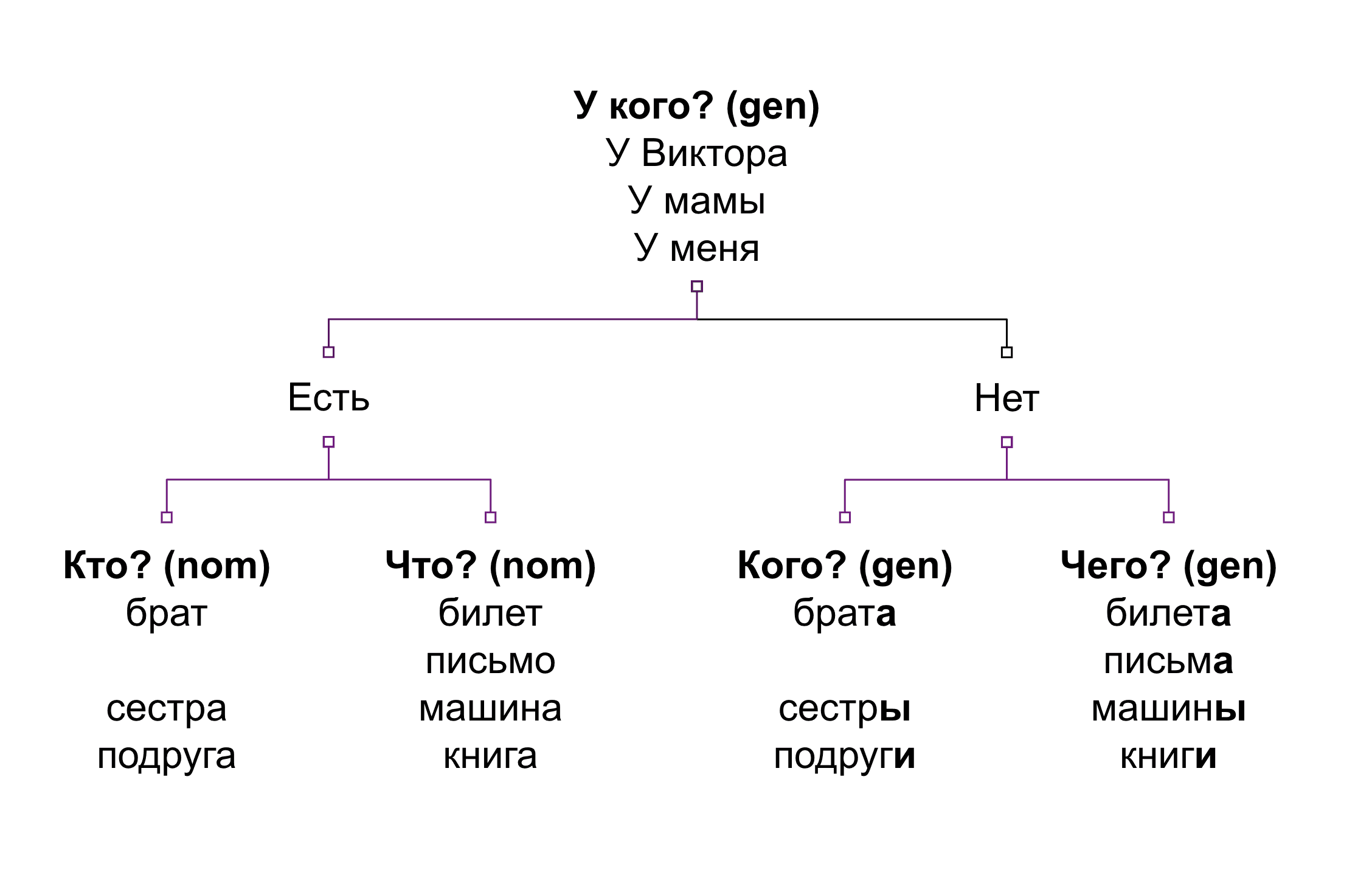
In the same way as possession, we express absence in Russian. However, instead of есть (there is/are), Russian uses нет (there is/are no). The noun that names the object then changes to the genitive case:
- У меня́ есть кни́га. (I have a book.)
- У меня́ нет кни́ги. (I don’t have a book.)
The genitive here signals absence. The object is treated as something that does not exist in the situation.
Here is the same idea in a visual form. Follow the arrows: when we say есть, we use the nominative. When we say нет, we switch to the genitive.
3) Quantity and Numbers
If you're new to Russian numbers, you can read more about them in this article: How to Use Russian Cardinal Numbers Correctly.
The genitive is also used when we talk about quantities. After numbers and quantity words, the noun becomes grammatically dependent on the number. After 2, 3, and 4, nouns usually appear in a genitive singular form. After 5 and higher numbers, they usually appear in the genitive plural. The form depends on the last word of the number, not just on the digit itself. That is why “22 cats” is два́дцать два кота́ – the noun is in the genitive singular because the final word is два. But “12 cats” is двена́дцать кото́в – the noun is in the genitive plural because numbers 11-19 follow the same pattern as numbers ending in 5-9. The same pattern also applies to numbers ending in 0. Here is the pattern in a table:
| 1 (оди́н) кот - nominative singular | 21 (два́дцать оди́н) кот - nominative singular | 11 (оди́ннадцать) кото́в - genitive plural |
| 2 (два) кота́ - genitive singular | 32 (три́дцать два) кота́ - genitive singular | 12 (двена́дцать) кото́в - genitive plural |
| 5 (пять) кото́в - genitive plural | 45 (со́рок пять) кото́в - genitive plural | 15 (пятна́дцать) кото́в - genitive plural |
| 10 (де́сять) кото́в - genitive plural | | |
We also use the genitive case after words expressing quantity. With countable nouns, we usually use the genitive plural. With uncountable nouns, we use the genitive singular.
- мно́го кото́в (many cats)
- немно́го люде́й (a few people)
- не́ско́лько слов (several words)
- ма́ло вре́мени (little time)
- ско́лько воды́ (how much water)
In these expressions, the noun does not stand alone — it depends on the quantity word, which is why it appears in the genitive case.
4) “Of” Relationships
In many situations where English uses the preposition “of”, Russian simply removes the preposition and puts the second noun in the genitive case. Instead of saying “of,” Russian changes the form of the noun. This usage can be divided into four main categories.
Titles and Descriptions (English “of” phrases) – here, the second noun describes or defines the first one:
- портре́т Пу́шкина (portrait of Pushkin)
- Москва́ — столи́ца Росси́и (Moscow is the capital of Russia)
- ка́рта ми́ра (map of the world)
Possession and Ownership (English ’s) – in English, we often use “’s” to show possession. In Russian, this relationship is expressed with the genitive:
- и́мя студе́нта (the student’s name / name of the student)
- ру́чка сестры́ (the sister’s pen / pen of the sister)
- Оле́г — брат Та́ни (Oleg is Tanya’s brother / brother of Tanya)
Authorship – the genitive is also used to show who created something:
- расска́зы Че́хова (short stories by Chekhov)
- стихи́ Есе́нина (poems by Yesenin)
- карти́на Ши́шкина «У́тро в сосно́вом лесу́» (painting by Shishkin “Morning in a Pine Forest”)*
Note: In English, we often translate this as “by,” not “of,” even though the Russian structure is genitive.
Whole and Part Relationships – when something is part of something bigger, Russian uses the genitive:
- бе́рег мо́ря (shore of the sea)
- колесо́ маши́ны (wheel of the car)
- кры́ша дома́ (roof of the house)
*«У́тро в сосно́вом лесу́» (Morning in a Pine Forest) is usually known as a painting by Ivan Shishkin. He painted the forest itself. According to a popular story, the painting originally had no bears, and viewers found it beautiful but somewhat empty. Later, the bears were added by Konstantin Savitsky, and they became the most memorable part of the scene.
Below is the painting:

Understanding this underlying idea makes the genitive more predictable. Rather than memorizing isolated rules, look for the concept: something absent, measured or dependent. When you recognize that pattern, the genitive case becomes much easier to identify and use correctly.
The next step in understanding the genitive case is this article: Genitive Case: Basics – Nouns and Personal Pronouns. You'll also find exercises there to practice all the uses we’ve talked about.
Take a deep breath — that was the genitive. From here on, things get easier. 😉
The Dative Case (Да́тельный паде́ж)
The dative case is used when something is given to someone, directed toward someone, or happens to someone. It answers the questions кому́? чему́? (to whom? to what?).
If the genitive often shows absence or dependence, the dative usually shows a recipient or experiencer — the person who receives something or is affected by something.
1) Indirect Object
The most common use of the dative is the indirect object — the person who receives something. In English, this is often expressed with “to”, while in Russian, the receiver appears in the dative case:
- Я пишу́ дру́гу. (I write to a friend.)
- Дай кни́гу А́не. (Give the book to Ania.)
Common verbs that require the dative:
- дава́ть / дать (to give)
- говори́ть / сказа́ть (to tell / to say)
- писа́ть / написа́ть (to write)
- звони́ть / позвони́ть (to call)
- обеща́ть / пообеща́ть (to promise)
- помога́ть / помо́чь (to help)
The person in the dative is the one who receives the action. Notice that in Russian, even “to help” requires the dative (помога́ть кому́?), while in English we say “help someone” without “to.”
2) Indirect Structures
The dative is also used in sentences where something happens to a person, rather than the person actively doing something. You may remember this idea from the “I have” construction. In these structures, the person is not the grammatical subject. Instead, the feeling, state, or object becomes the subject.
The “I like” construction works in the same way (just like Spanish me gusta):
dative (person who likes) + нра́вится/нра́вятся (to be liked) + nominative (thing that is liked).
For example, in the sentence Мне нра́вится кот. (“I like a cat.”), the word кот (cat) is the grammatical subject of the sentence, and мне (“to me”) is the pronoun я (I) in the dative case. Literally this sentence can be translated as “A cat is pleasing to me.”
The same indirect structure appears in sentences with:
| | Russian | Literal translation | Natural translation |
|---|---|---|---|
| ну́жно / на́до (to be necessary) | Мне ну́жно позвони́ть. | To call is necessary to me. | I need to call. |
| мо́жно (is allowed) | Де́тям мо́жно игра́ть во дворе́. | To play in the yard is allowed to children. | Children can play in the yard. |
| feelings | Тебе́ хо́лодно? | Is it cold to you? | Are you cold? |
| | Ему́ ве́село. | It's fun to him. | He is having fun. |
In all of these examples, the person is not actively doing something. Instead, something happens to them — they receive something, experience something, or something is necessary for them. That is why the person appears in the dative case.
Ready to go deeper? Dative Case: Basics – Nouns and Personal Pronouns walks you through the forms step by step, with exercises to make them stick.
The Accusative Case (Вини́тельный паде́ж)
The accusative case is used for the direct object — the person or thing that receives the action directly. It answers the questions кого́? что? (whom? what?). When someone actively does something to an object, that object usually appears in the accusative case.
In Russian, the same way as in English, the direct object follows the verb, but also changes its form to the accusative case:
- Я люблю́ кни́ги. (I love books.)
- Мы и́щем кварти́ру. (We are looking for an apartment.)
- Она́ чита́ет газе́ту. (She is reading a newspaper.)
Here, кни́ги, кварти́ру, and газе́ту are in the accusative because they receive the action.
Common verbs that require the accusative:
- ви́деть (to see)
- люби́ть (to love)
- хоте́ть (to want)
- иска́ть / найти́ (to look for / to find)
- чита́ть / прочита́ть (to read)
- изуча́ть (to study)
- покупа́ть / купи́ть (to buy)
Basically, if you can ask “what?” after the verb, the answer is usually in the accusative.
Learn how to form the accusative case in this article: Accusative Case: Basics — Nouns and Personal Pronouns. You’ll also find exercises there to help you practice.
The Instrumental Case (Твори́тельный паде́ж)
The instrumental case is used to show with whom or with what an action is done. It answers the questions кем? чем? (with whom? with what?). The name “instrumental” comes from the idea of an instrument — a tool or means by which something is done.
1) With Someone
When two people do something together, Russian uses the preposition с (with) + the instrumental case.
- Я говорю́ с ма́мой. (I am talking with mom.)
- Мы встре́тились с кома́ндой. (We met with the team.)
Here, ма́мой and кома́ндой are in the instrumental because they show who participates in the action together with the subject.
Common verbs used with с + instrumental:
- встреча́ться / встре́титься c (to meet with)
- знако́миться / познако́миться c (to get acquainted with)
- разгова́ривать c (to talk with)
If you mean “together with someone,” the instrumental is usually involved.
2) Instrument or Tool
The instrumental case is also used to show the tool or means by which something is done. Notice that English also uses “with” in this situation.
- Я пишу́ ру́чкой. (I write with a pen.)
- Я откры́ла дверь ключо́м. (I opened the door with a key.)
The words ру́чкой and ключо́м show the instrument used to perform the action.
We also use the instrumental case with the following verbs:
- занима́ться (to be engaged in, to practice) – Я занима́юсь йо́гой. (I practice yoga.)
- интересова́ться (to be interested) – Студе́нт интересу́ется исто́рией. (A student is interested in history.)
- стать (to become) – Он хо́чет стать футболи́стом. (He wants to become a football player.)
In these structures, the instrumental shows the field, activity, or role connected to the person.
Curious how the endings actually work? Instrumental Case: Basics – Nouns and Personal Pronouns covers every form, with exercises to practice.
The Prepositional Case (Предло́жный паде́ж)
The prepositional case is used after certain prepositions. It usually answers two main questions:
- Где? (Where?)
- О ком? О чём? (About whom? About what?)
As the name suggests, this case always appears with a preposition.
1) Location — Where?
The prepositional case is used to talk about location when answering the question “Where?” It commonly appears after the prepositions в (in) and на (on). If you are not sure when to use each preposition, check out this article: В vs На — In / On / At in Russian.
- Я живу́ в Москве́. (I live in Moscow.)
- Кни́ги стоя́т на по́лке. (The books are/stand on the shelf.)
Common verbs used with location:
- жить (to live)
- рабо́тать (to work)
- отдыха́ть (to rest / be on vacation)
- учи́ться (to study)
If you are answering the question “Where?” and there is no movement involved, you will usually need the prepositional case.
2) About Something
The prepositional case is also used after the preposition о (about). It shows the topic of thinking, speaking, or remembering.
- Я ду́маю о друзья́х. (I am thinking about friends.)
- Мы говори́ли о прое́кте. (We talked about the project.)
Common verbs:
- ду́мать (to think)
- говори́ть (to talk)
- вспомина́ть (to remember, to recall)
When you're ready to learn the actual endings, here's the full formation guide: Prepositional Case: Basics.
You’ve now seen all six cases. Each case answers its own type of question and shows a specific relationship between words.
At first, the system may seem overwhelming. But once you stop memorizing endings and start noticing the logic — who does the action, who receives it, where it happens, what is affected — the patterns become much clearer. And that’s when Russian grammar stops feeling chaotic and starts making sense.
Ready to practice? Reading about grammar is one thing — using it is where it really clicks. I've put together free Russian exercises on all sorts of topics: cases, verbs, numbers, vocabulary and more. Pick whatever you're working on, give it a try, and check your answers as you go.